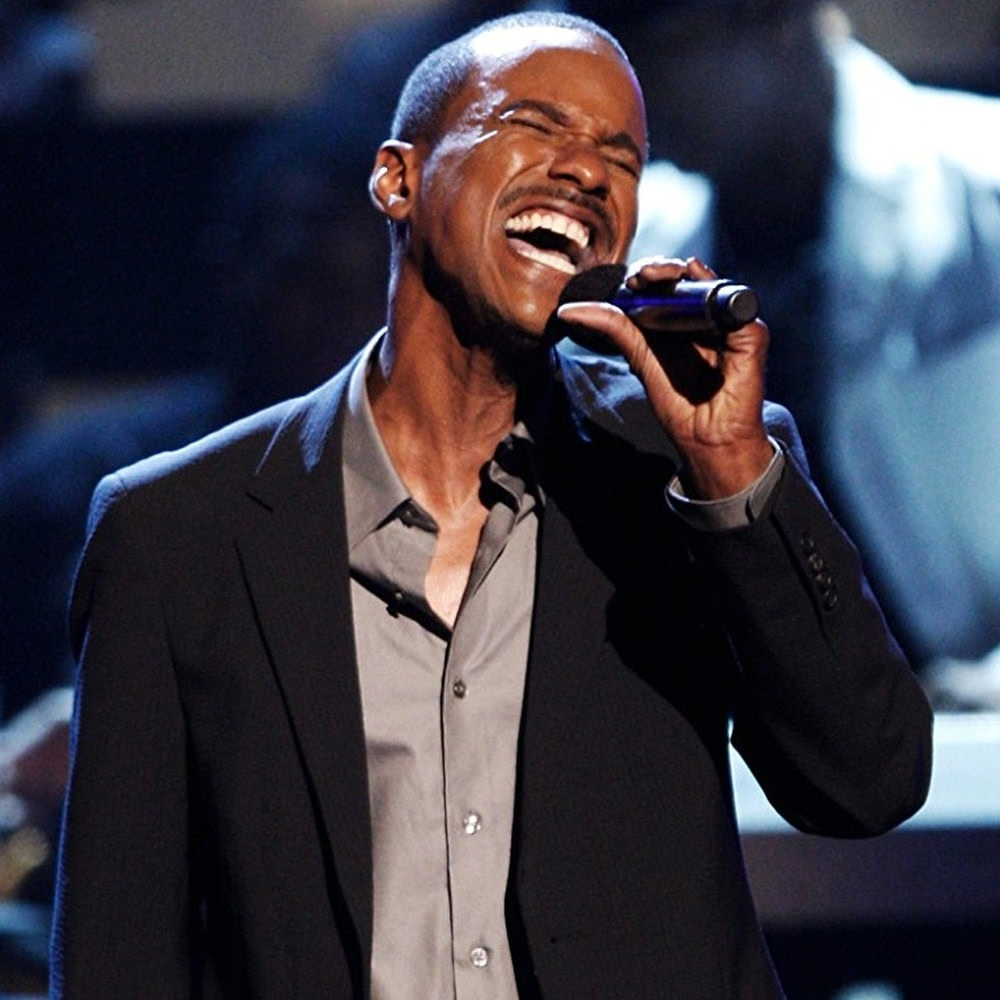
Tevin Campbell
1976 –
He walked into a recording studio at twelve years old, opened his mouth, and sang with a control that most adult vocalists spend decades trying to develop. Tevin Campbell was born in Waxahachie, Texas, in 1976, and his voice was discovered by jazz flutist Bobbi Humphrey when he auditioned for a local talent show in Dallas. She recognized immediately that the voice was not just good for a child -- it was exceptional by any standard.
She sent him to Quincy Jones, who put the boy on the track Back on the Block in 1990, and the music industry decided that Tevin Campbell was going to be a star whether he was ready or not.

"Can we talk for a minute?
Girl, I want to know your name"

-- from Can We Talk

The cost was growing up in public under an unforgiving spotlight. Campbell's debut album T.E.V.I.N. in 1991 was a commercial success, produced by Prince and featuring the single Round and Round. He was fifteen years old, touring the country, performing on Arsenio Hall and Soul Train, and the industry treated him like a product to be marketed rather than a teenager still developing. The pressure to deliver hits at a pace that matched adult expectations was relentless, and he had no template for how to handle it because there was no other fifteen-year-old with his level of success. He kept delivering anyway. His second album I'm Ready in 1993 produced the singles Can We Talk and I'm Ready, both of which became enduring classics of 1990s R&B. Can We Talk spent eight weeks at number one on the R&B chart.

I'm Ready is the one. The title track showed a voice that had matured significantly since T.E.V.I.N. in just two years. The boy was becoming a young man, and the songs reflected that transition -- still youthful in spirit, but with an awareness that the world was bigger than the recording studio. The album went platinum. He toured with Michael Jackson and performed at the Grammy Awards. For a few years, the industry's bet paid off and everything worked according to plan.

The machine slowed down after the 1990s ended. Campbell faced personal and legal struggles that interrupted his momentum, and the R&B landscape shifted toward a harder, more urban sound that did not fit his vocal style. He continued recording and performing, but the peak years of the early 1990s were not repeated. What remains is a catalog of songs that defined a generation of Black teen romance -- innocent, earnest, sung by a voice that had no business belonging to someone so young. Can We Talk still plays at every slow dance that matters, and that is a legacy that no chart position can capture.

Image Credits

1,414 artist portraits across 5 genres (Rock, Jazz, Soul, Blues, Folk). 1,363 sourced from Wikipedia (Creative Commons / Public Domain), 50 from Deezer (promotional artwork).

Full attribution breakdown →

Tevin Campbell

1976 –
He walked into a recording studio at twelve years old, opened his mouth, and sang with a control that most adult vocalists spend decades trying to develop. Tevin Campbell was born in Waxahachie, Texas, in 1976, and his voice was discovered by jazz flutist Bobbi Humphrey when he auditioned for a local talent show in Dallas. She recognized immediately that the voice was not just good for a child -- it was exceptional by any standard.
She sent him to Quincy Jones, who put the boy on the track Back on the Block in 1990, and the music industry decided that Tevin Campbell was going to be a star whether he was ready or not.

"Can we talk for a minute?
Girl, I want to know your name"

-- from Can We Talk

The cost was growing up in public under an unforgiving spotlight. Campbell's debut album T.E.V.I.N. in 1991 was a commercial success, produced by Prince and featuring the single Round and Round. He was fifteen years old, touring the country, performing on Arsenio Hall and Soul Train, and the industry treated him like a product to be marketed rather than a teenager still developing. The pressure to deliver hits at a pace that matched adult expectations was relentless, and he had no template for how to handle it because there was no other fifteen-year-old with his level of success. He kept delivering anyway. His second album I'm Ready in 1993 produced the singles Can We Talk and I'm Ready, both of which became enduring classics of 1990s R&B. Can We Talk spent eight weeks at number one on the R&B chart.

I'm Ready is the one. The title track showed a voice that had matured significantly since T.E.V.I.N. in just two years. The boy was becoming a young man, and the songs reflected that transition -- still youthful in spirit, but with an awareness that the world was bigger than the recording studio. The album went platinum. He toured with Michael Jackson and performed at the Grammy Awards. For a few years, the industry's bet paid off and everything worked according to plan.

The machine slowed down after the 1990s ended. Campbell faced personal and legal struggles that interrupted his momentum, and the R&B landscape shifted toward a harder, more urban sound that did not fit his vocal style. He continued recording and performing, but the peak years of the early 1990s were not repeated. What remains is a catalog of songs that defined a generation of Black teen romance -- innocent, earnest, sung by a voice that had no business belonging to someone so young. Can We Talk still plays at every slow dance that matters, and that is a legacy that no chart position can capture.

contemporary r&bdance-popfunk / soulsoulurban
The Sunday Drop
One song. One story. Every Sunday.

No algorithms. No trending sections. Just a song someone loved and the story behind it. Delivered Sunday morning.

Free. No spam. Unsubscribe anytime.

Image Credits

1,414 artist portraits across 5 genres (Rock, Jazz, Soul, Blues, Folk). 1,363 sourced from Wikipedia (Creative Commons / Public Domain), 50 from Deezer (promotional artwork).

Full attribution breakdown →

0:00
0:00
The Sunday Drop One song. One story. Every Sunday.