"They told him don't you ever come around here
Don't want to see your face, you better disappear"
-- from Billie Jean
The price of that transformation was staggering. Michael Jackson spent his childhood in recording studios, on tour buses, and in front of cameras. His father Joseph was a disciplinarian who admitted to beating his children with belts and extension cords. Michael later said he would vomit from fear before Joseph entered the room. The stage was where he felt safe. The safety came at the cost of any normal adolescence, and the cost compounded as he aged -- the surgeries, the isolation at Neverland, the addiction to propofol, the accusations that shadowed his final decades. The work and the damage occupied the same body, and neither could be separated from the other.
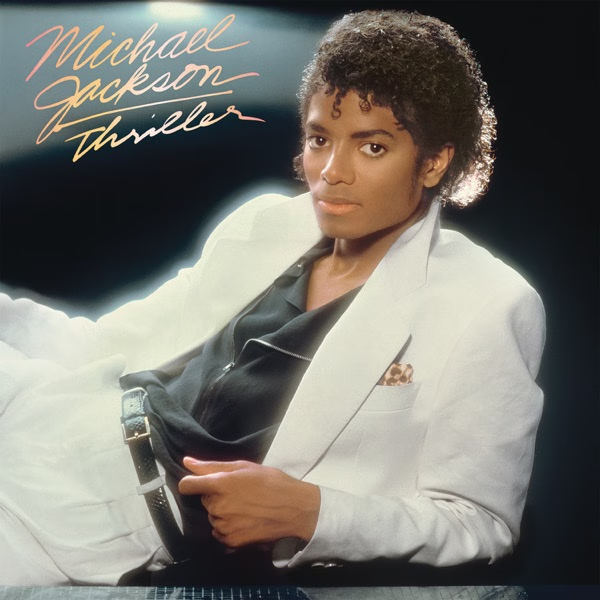
Off the Wall (1979) was the announcement. Quincy Jones produced it, Rod Temperton wrote "Rock with You," and Michael sang with a lightness he had never shown before -- less Jackson 5 precision, more adult nuance. The album sold twenty million copies and proved he could survive outside his brothers' shadow. Then came Thriller (1982). No album had ever worked on this many levels. "Billie Jean" had a bassline that sounded like a confession and a vocal that sounded like a warning. "Beat It" brought Eddie Van Halen's guitar into a pop song and made the crossover sound inevitable. The title track was a horror-film short directed by John Landis, fourteen minutes long, with a dance sequence that every child in America learned by heart. Thriller sold over seventy million copies worldwide and changed the music video from a promotional tool into an art form. The moonwalk on Motown 25, performed live in 1983, was not a dance move -- it was a physical argument that pop music could be as virtuosic as ballet and as democratic as a block party.
The legacy of Michael Jackson is a contradiction that cannot be resolved. The music is beyond dispute -- "Billie Jean," "Thriller," "Human Nature," "Don't Stop 'Til You Get Enough," the one gloved hand spinning in the spotlight. He took Black pop and made it the default global sound, not by assimilating but by expanding what the form could hold. The allegations and the acquittals and the settlements and the documentaries live in the same space. There is no clean version of this story. What remains is the body in motion, the voice in the upper register, and the fact that every pop star who came after him -- from Usher to Bruno Mars to Beyonce -- learned to move the way he moved first.
Michael Jackson was profiled in the documentary, Leaving Neverland, in 2019.