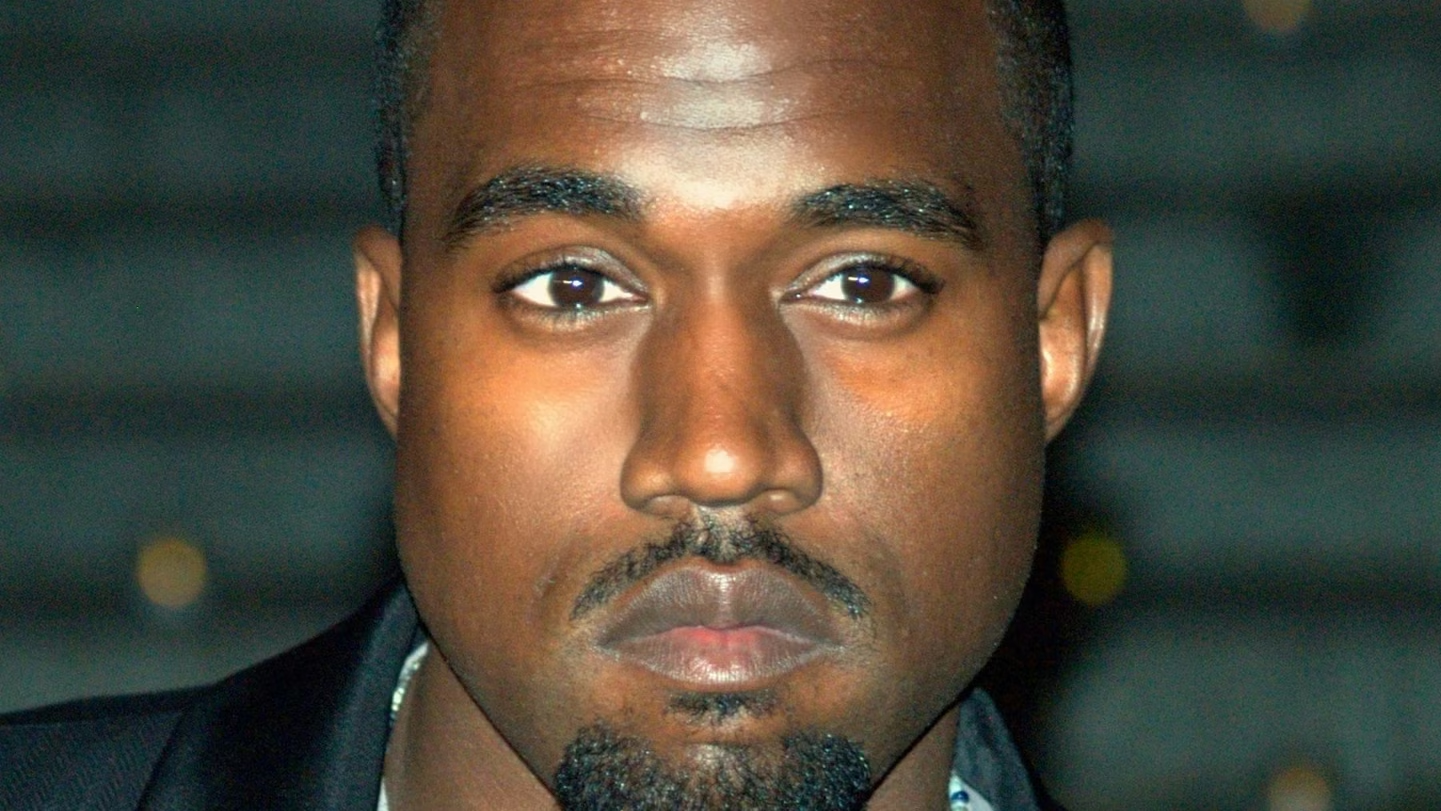
Kanye West

There is no artist in the 21st century who has inspired more conversation, more debate, more love, and more fury than Kanye West. Born June 8, 1977 in Atlanta and raised in Chicago, Kanye Omari West emerged not as a rapper first but as a producer. He made beats for Jay-Z, for Talib Kweli, for Mos Def, for a who's-who of late-90s hip-hop.

His signature sound -- speeding up old soul samples into chipmunk-pitched loops -- became the sound of Roc-A-Fella Records. But Kanye wanted to rap. The labels told him no. They said he wasn't street enough. He was the kid with the polo shirt and the backpack, the one who rapped about family and faith and consumerism instead of guns and drugs. They told him to stay behind the boards. He responded by making The College Dropout entirely on his own terms, then watching it sell three million copies and change what hip-hop could be.

The decade that followed was a masterclass in creative restlessness. Late Registration (2005) expanded his palette with orchestrations from Jon Brion. Graduation (2007) pushed toward stadium-sized electro-rap. 808s & Heartbreak (2008) was a radical pivot into Auto-Tuned vulnerability after his mother's death, an album that directly influenced a generation of emo-rap artists. Then came My Beautiful Dark Twisted Fantasy (2010), a maximalist magnum opus that many consider his finest work. He kept going: Yeezus (2013) was industrial noise as rebellion; The Life of Pablo (2016) was a gospel-rap collage that he kept revising even after release; Ye (2018) was a raw seven-song confession. He never stopped changing, never stopped risking his own legacy on the next experiment.

But Kanye West is not just music. He is a cultural force that spills across mediums. He has designed for Louis Vuitton and Nike, launched the Yeezy brand with Adidas and turned it into a billion-dollar business. He has called himself a genius, a god, a visionary -- and even when the world laughed, he kept showing up.

The College Dropout (2004)

He interrupted Taylor Swift at the VMAs and turned himself into a permanent headline. He married Kim Kardashian, had four children, then went through a very public divorce. He ran for president. He made albums in Wyoming. He converted to Christianity and started Sunday Service, a gospel choir that performed everywhere from Coachella to a parking lot in Calabasas. Every phase of his life has been turned into content, and he has never asked permission to exist as loudly as he wants to.

The cost of being Kanye West is exhaustion. He has been diagnosed with bipolar disorder, and his public episodes have been painful to watch -- manic rants, antisemitic comments, a public unraveling that cost him partnerships, respect, and a $1.5 billion fortune. He said things that were indefensible, and then he said he was sorry, and then he did it again. The same audacity that made him a genius also made him impossible. He has been canceled dozens of times and always, somehow, managed to find a way back. His relationship with the public is a cycle of outrage, forgiveness, and relapse. He is the most fascinating and frustrating public figure of his generation.

And yet. When you strip away the controversy, the headline, the ego, what remains is the music. The College Dropout still sounds like a revelation. Gold Digger still hits like a truck. Runaway is still one of the most honest breakup songs ever written. Jesus Walks is still a declaration of faith that hip-hop had never heard before and hasn't heard since. Kanye West changed the sound of popular music -- not once, but five or six times, across two decades. He proved that a Black artist from Chicago could be a producer, a rapper, a fashion designer, a mogul, a madman, and a prophet all at once. He bent the culture to his will, and even when the culture pushed back, he didn't break. He bent some more.

Image Credits

1,414 artist portraits across 5 genres (Rock, Jazz, Soul, Blues, Folk). 1,363 sourced from Wikipedia (Creative Commons / Public Domain), 50 from Deezer (promotional artwork).

Full attribution breakdown →

Kanye West

There is no artist in the 21st century who has inspired more conversation, more debate, more love, and more fury than Kanye West. Born June 8, 1977 in Atlanta and raised in Chicago, Kanye Omari West emerged not as a rapper first but as a producer. He made beats for Jay-Z, for Talib Kweli, for Mos Def, for a who's-who of late-90s hip-hop.

His signature sound -- speeding up old soul samples into chipmunk-pitched loops -- became the sound of Roc-A-Fella Records. But Kanye wanted to rap. The labels told him no. They said he wasn't street enough. He was the kid with the polo shirt and the backpack, the one who rapped about family and faith and consumerism instead of guns and drugs. They told him to stay behind the boards. He responded by making The College Dropout entirely on his own terms, then watching it sell three million copies and change what hip-hop could be.

The decade that followed was a masterclass in creative restlessness. Late Registration (2005) expanded his palette with orchestrations from Jon Brion. Graduation (2007) pushed toward stadium-sized electro-rap. 808s & Heartbreak (2008) was a radical pivot into Auto-Tuned vulnerability after his mother's death, an album that directly influenced a generation of emo-rap artists. Then came My Beautiful Dark Twisted Fantasy (2010), a maximalist magnum opus that many consider his finest work. He kept going: Yeezus (2013) was industrial noise as rebellion; The Life of Pablo (2016) was a gospel-rap collage that he kept revising even after release; Ye (2018) was a raw seven-song confession. He never stopped changing, never stopped risking his own legacy on the next experiment.

But Kanye West is not just music. He is a cultural force that spills across mediums. He has designed for Louis Vuitton and Nike, launched the Yeezy brand with Adidas and turned it into a billion-dollar business. He has called himself a genius, a god, a visionary -- and even when the world laughed, he kept showing up.

The College Dropout (2004)

He interrupted Taylor Swift at the VMAs and turned himself into a permanent headline. He married Kim Kardashian, had four children, then went through a very public divorce. He ran for president. He made albums in Wyoming. He converted to Christianity and started Sunday Service, a gospel choir that performed everywhere from Coachella to a parking lot in Calabasas. Every phase of his life has been turned into content, and he has never asked permission to exist as loudly as he wants to.

The cost of being Kanye West is exhaustion. He has been diagnosed with bipolar disorder, and his public episodes have been painful to watch -- manic rants, antisemitic comments, a public unraveling that cost him partnerships, respect, and a $1.5 billion fortune. He said things that were indefensible, and then he said he was sorry, and then he did it again. The same audacity that made him a genius also made him impossible. He has been canceled dozens of times and always, somehow, managed to find a way back. His relationship with the public is a cycle of outrage, forgiveness, and relapse. He is the most fascinating and frustrating public figure of his generation.

And yet. When you strip away the controversy, the headline, the ego, what remains is the music. The College Dropout still sounds like a revelation. Gold Digger still hits like a truck. Runaway is still one of the most honest breakup songs ever written. Jesus Walks is still a declaration of faith that hip-hop had never heard before and hasn't heard since. Kanye West changed the sound of popular music -- not once, but five or six times, across two decades. He proved that a Black artist from Chicago could be a producer, a rapper, a fashion designer, a mogul, a madman, and a prophet all at once. He bent the culture to his will, and even when the culture pushed back, he didn't break. He bent some more.

The College Dropout (2004) The College Dropout (2004)
Late Registration (2005) Late Registration (2005)
Graduation (2007) Graduation (2007)
808s & Heartbreak (2008) 808s & Heartbreak (2008)
My Beautiful Dark Twisted Fantasy (2010) My Beautiful Dark Twisted Fantasy (2010)
The College Dropout (2004)
Late Registration (2005)
Graduation (2007)
808s & Heartbreak (2008)
My Beautiful Dark Twisted Fantasy (2010)
hip-hopconsciousexperimental
The Sunday Drop
One song. One story. Every Sunday.

No algorithms. No trending sections. Just a song someone loved and the story behind it. Delivered Sunday morning.

Free. No spam. Unsubscribe anytime.

Image Credits

1,414 artist portraits across 5 genres (Rock, Jazz, Soul, Blues, Folk). 1,363 sourced from Wikipedia (Creative Commons / Public Domain), 50 from Deezer (promotional artwork).

Full attribution breakdown →

0:00
0:00