Written by Richard Rodgers and Oscar Hammerstein II
This one wanders a little from our usual home of Soul, R&B, Funk and Gospel song-telling. It’s for my brother-in-law -- a percussionist, and someone I loved -- who we lost this week.
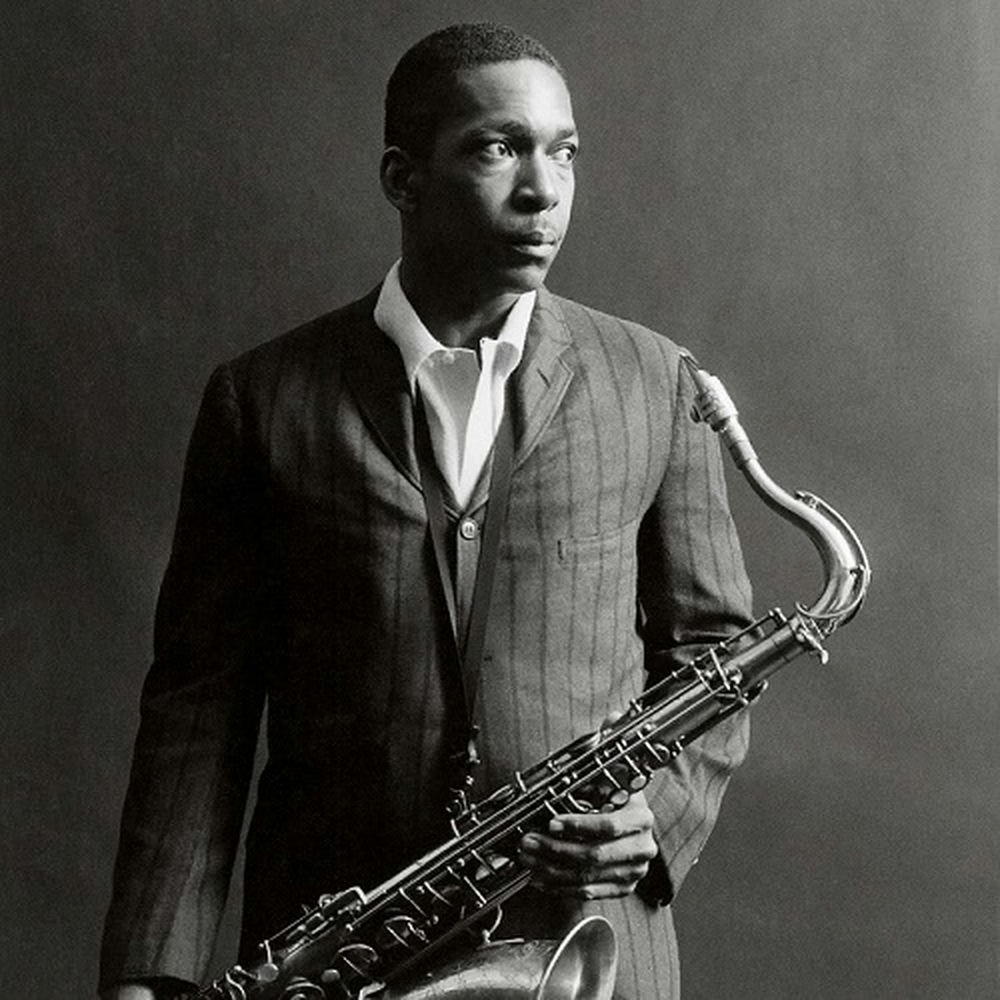
John Coltrane in 1963, three years after the My Favorite Things sessions.
They call it a waltz. Rodgers and Hammerstein wrote it in 3/4 time, Mary Martin sang it on Broadway in under three minutes, and the lyrics listed off raindrops on roses and whiskers on kittens like a child counting blessings before sleep. A midtempo show tune about the small things that keep a person tethered to joy. Harmless. Charming. The kind of song you hum while hanging laundry.
Then John Coltrane got hold of it.
My Favorite Things
Listen while you read: My Favorite Things | My Favorite Things | 1961
The Show Tune That Wasn’t
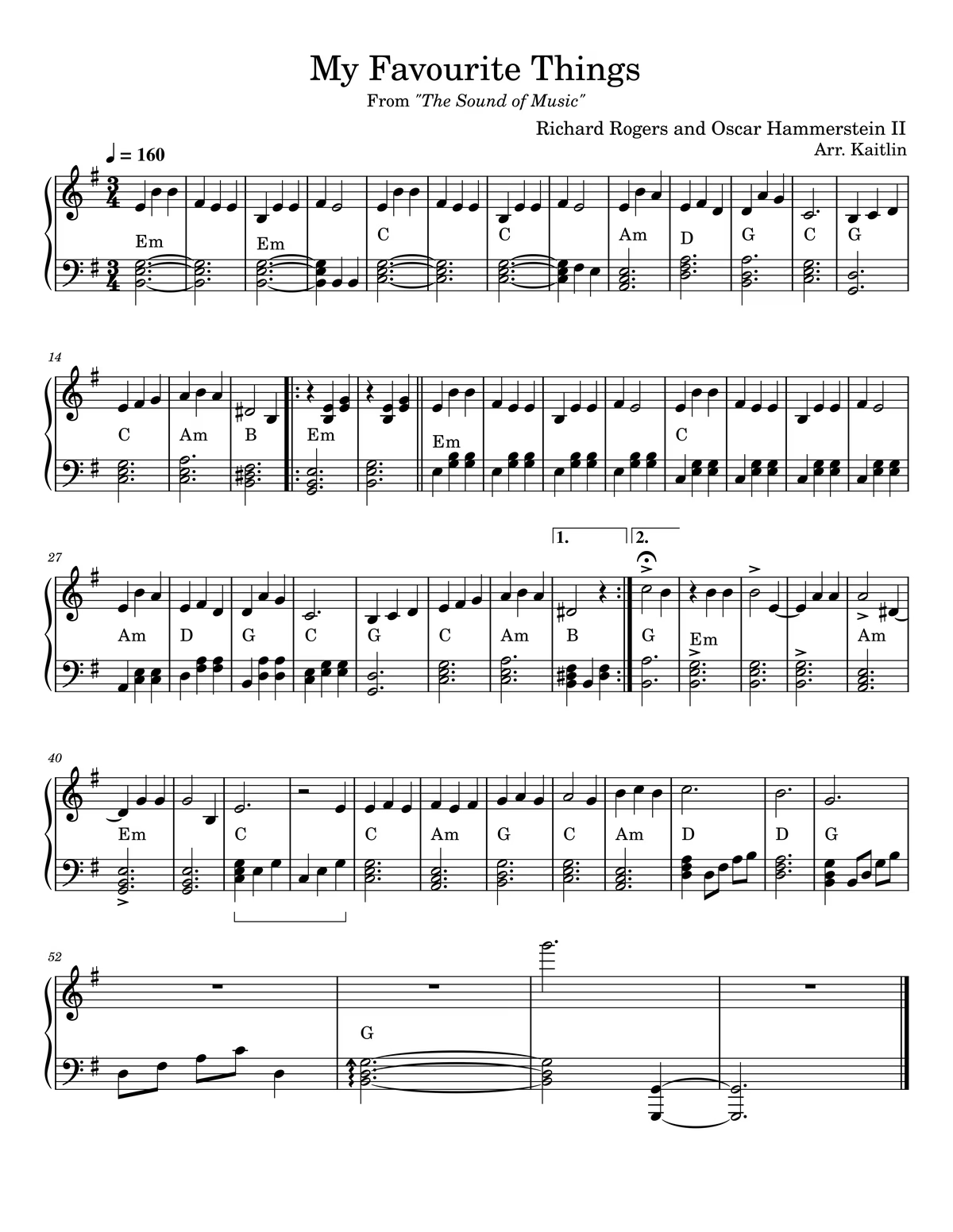
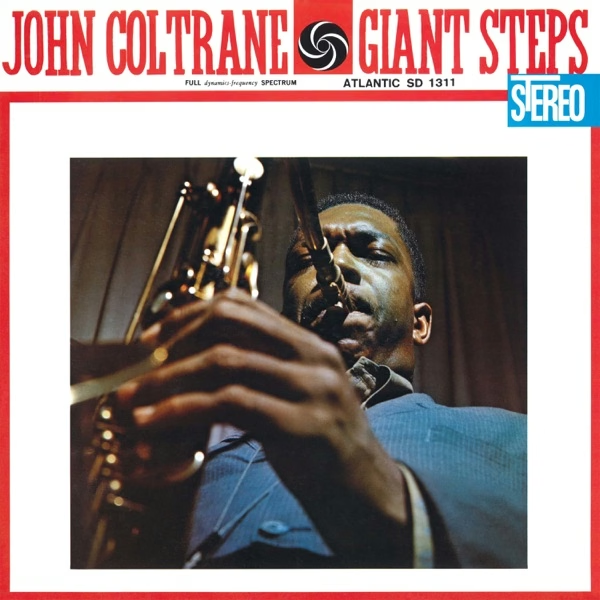
Original sheet music for My Favorite Things by Richard Rodgers and Oscar Hammerstein II.Giant Steps (1960)
What Coltrane heard in that melody was not a waltz at all. He heard a door. This was the man who had already recorded Giant Steps, an album so harmonically dense that musicians spent years learning to navigate it. He had been inside Kind of Blue with Miles Davis, helping invent the modal approach that made records like this one possible. What he heard in "My Favorite Things" was the next territory.
Rodgers had built the verses in E minor, a key most Broadway composers of 1959 treated as a passing mood rather than a destination. The bridge shifted to the relative major, the song ended with a Picardy-third turn to E major, and somewhere in that flicker between minor and major -- between what the tune said and what it meant -- Coltrane found the architecture for something the Broadway stage had never imagined.
He stripped the song down to two modal plateaus, E minor and E major, and refused to follow it back to G major where Rodgers had intended it to land. The melody appears throughout, but not as something to return to. It appears as an anchor. A familiar shape the band orbits and departs from and returns to, each time from a different angle. This Nobody was doing this in jazz in 1960. Coltrane did it anyway.>
The Quartet That Found Its Voice
The quartet that made it happen was young and barely road-tested. McCoy Tyner on piano was 21, a Philadelphia prodigy whose left hand built chords pianists weren't supposed to build -- fourth-based harmonies that floated like clouds over a static bass. Steve Davis on bass was 31, also from Philadelphia, and he bowed a single open E string for nearly the entire 13 minutes and 41 seconds of the title track, turning a monotone into a foundation. Elvin Jones on drums was 33, a veteran who had played with everyone from Art Farmer to Gil Evans to Miles Davis, and he rode the cymbal on the “and of one” -- a rhythmic displacement so persistent it created its own gravitational field.
Lewis Porter's biography maps Coltrane's solos note for note, showing how he stopped playing the chord changes and started playing the air around them. Michael Titlestad, writing in English Studies in Africa, calls the melody a "departure point and a touchstone" -- a familiar shape Coltrane used to anchor his most volatile explorations.
You can hear that volatility in the numbers. The crisp 1960 studio version runs 13 minutes and 41 seconds. By 1963 at Newport it had stretched to 20 minutes. By 1965 it was 30. By 1966 in Tokyo, Coltrane and the band took it to 57 minutes -- a single song longer than most albums. Play those four recordings in order and it stops sounding like the same tune. You're watching one man reshape the same piece of material every time he touched it, remaking it so completely that the original became almost unrecognizable. The framework they use is Henry Louis Gates Jr.'s theory of Signifyin(g) -- parody, irony, and pastiche as the tools of cultural revision. Others push back on that reading, arguing that framing the track as an "improvement" on a "corny original" carries its own set of assumptions about whose music gets to be called art. The debate itself is evidence of what the recording set in motion. It is not a cover. It is a dismantling and a rebuilding, and the seams show if you know where to look.
Atlantic Records released an edited version as a 45 RPM single in 1961, splitting the 14-minute track across both sides at roughly 2:45 each. Radio DJs played it heavily. A Black avant-garde jazz musician playing a Broadway show tune on an obscure instrument became a genuine pop radio hit. The album moved 50,000 units in its first year, a number jazz records almost never hit. It was inducted into the Grammy Hall of Fame in 1998 and certified Gold by the RIAA in 2018 -- 500,000 copies sold, a milestone almost unheard of for a jazz LP. Phil Lesh of the Grateful Dead later recalled urging his bandmates to study how Coltrane's quartet took simple structures and extended them far beyond their original length, a lesson that shaped the Dead's own approach to improvisation.
Early Death and Enduring Legacy
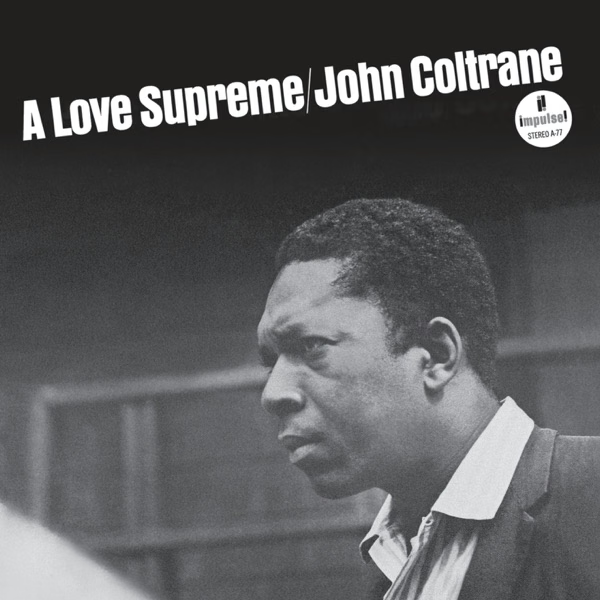
John Coltrane died of liver cancer on July 17, 1967, at 40 years old. He was buried at Pinelawn Memorial Park in Farmingdale, New York. In the span of a decade, he had changed the shape of jazz, of improvisation, of what a saxophone could say. He was part of two of the three most critically acclaimed jazz albums ever recorded -- Kind of Blue and his own A Love Supreme. The third was led by somebody else.
Coltrane told Down Beat in 1960: “I’ve found you’ve got to look back at the old things and see them in a new light.” And that’s just what he did -- he took a gentle little song about raindrops and kittens and, somehow, turned it into a fourteen-minute meditation on what it even means to improvise. “There is never any end,” he said. “There are always new sounds to imagine; new feelings to get at.” Maybe that’s the truest thing you could say about any of it. The song, the quartet, the man who picked up a soprano sax almost by accident and found a voice inside himself he never knew was there.
The man I’m dedicating this to would have understood that completely. He was a man who spent his whole life chasing new sounds to imagine, new feelings to get at. This one’s for him.
Sources: HotSupper research, Ingrid Monson's Saying Something (University of Chicago Press, 1996), Lewis Porter's John Coltrane: His Life and Music (University of Michigan Press, 1998), Michael Titlestad's "My Favourite Things" (English Studies in Africa, 2018), Henry Louis Gates Jr.'s theory of Signifyin(g), Justin A. Williams (2014), Alan Stanbridge's Rhythm Changes (2025), Ethan Hein Blog, Mixonline Classic Tracks (Tom Dowd interview), Open Culture, Wikipedia, AllMusic, Discogs.
jazzmodal-jazz1960sjohn-coltranesunday-drop
The Sunday Drop
One song delivered to your inbox every Sunday morning.
Join the readers who start their Sunday with a story they didn't know they needed.
The Sunday Drop
One song. One story. Every Sunday.
No algorithms. No trending sections. Just a song someone loved and the story behind it. Delivered Sunday morning.
✓Check your email to confirm.
Free. No spam. Unsubscribe anytime.
Image Credits
1,449 artist portraits across 5 genres (Rock, Jazz, Soul, Blues, Folk).
1,363 sourced from Wikipedia (Creative Commons / Public Domain), 50 from
Deezer (promotional artwork).
Written by Richard Rodgers and Oscar Hammerstein II
This one wanders a little from our usual home of Soul, R&B, Funk and Gospel song-telling. It’s for my brother-in-law -- a percussionist, and someone I loved -- who we lost this week.
John Coltrane in 1963, three years after the My Favorite Things sessions.
They call it a waltz. Rodgers and Hammerstein wrote it in 3/4 time, Mary Martin sang it on Broadway in under three minutes, and the lyrics listed off raindrops on roses and whiskers on kittens like a child counting blessings before sleep. A midtempo show tune about the small things that keep a person tethered to joy. Harmless. Charming. The kind of song you hum while hanging laundry.
Then John Coltrane got hold of it.
My Favorite Things
Listen while you read: My Favorite Things | My Favorite Things | 1961
The Show Tune That Wasn’t
Original sheet music for My Favorite Things by Richard Rodgers and Oscar Hammerstein II.Giant Steps (1960)
What Coltrane heard in that melody was not a waltz at all. He heard a door. This was the man who had already recorded Giant Steps, an album so harmonically dense that musicians spent years learning to navigate it. He had been inside Kind of Blue with Miles Davis, helping invent the modal approach that made records like this one possible. What he heard in "My Favorite Things" was the next territory.
Rodgers had built the verses in E minor, a key most Broadway composers of 1959 treated as a passing mood rather than a destination. The bridge shifted to the relative major, the song ended with a Picardy-third turn to E major, and somewhere in that flicker between minor and major -- between what the tune said and what it meant -- Coltrane found the architecture for something the Broadway stage had never imagined.
He stripped the song down to two modal plateaus, E minor and E major, and refused to follow it back to G major where Rodgers had intended it to land. The melody appears throughout, but not as something to return to. It appears as an anchor. A familiar shape the band orbits and departs from and returns to, each time from a different angle. This Nobody was doing this in jazz in 1960. Coltrane did it anyway.>
The Quartet That Found Its Voice
The quartet that made it happen was young and barely road-tested. McCoy Tyner on piano was 21, a Philadelphia prodigy whose left hand built chords pianists weren't supposed to build -- fourth-based harmonies that floated like clouds over a static bass. Steve Davis on bass was 31, also from Philadelphia, and he bowed a single open E string for nearly the entire 13 minutes and 41 seconds of the title track, turning a monotone into a foundation. Elvin Jones on drums was 33, a veteran who had played with everyone from Art Farmer to Gil Evans to Miles Davis, and he rode the cymbal on the “and of one” -- a rhythmic displacement so persistent it created its own gravitational field.
Lewis Porter's biography maps Coltrane's solos note for note, showing how he stopped playing the chord changes and started playing the air around them. Michael Titlestad, writing in English Studies in Africa, calls the melody a "departure point and a touchstone" -- a familiar shape Coltrane used to anchor his most volatile explorations.
You can hear that volatility in the numbers. The crisp 1960 studio version runs 13 minutes and 41 seconds. By 1963 at Newport it had stretched to 20 minutes. By 1965 it was 30. By 1966 in Tokyo, Coltrane and the band took it to 57 minutes -- a single song longer than most albums. Play those four recordings in order and it stops sounding like the same tune. You're watching one man reshape the same piece of material every time he touched it, remaking it so completely that the original became almost unrecognizable. The framework they use is Henry Louis Gates Jr.'s theory of Signifyin(g) -- parody, irony, and pastiche as the tools of cultural revision. Others push back on that reading, arguing that framing the track as an "improvement" on a "corny original" carries its own set of assumptions about whose music gets to be called art. The debate itself is evidence of what the recording set in motion. It is not a cover. It is a dismantling and a rebuilding, and the seams show if you know where to look.
Atlantic Records released an edited version as a 45 RPM single in 1961, splitting the 14-minute track across both sides at roughly 2:45 each. Radio DJs played it heavily. A Black avant-garde jazz musician playing a Broadway show tune on an obscure instrument became a genuine pop radio hit. The album moved 50,000 units in its first year, a number jazz records almost never hit. It was inducted into the Grammy Hall of Fame in 1998 and certified Gold by the RIAA in 2018 -- 500,000 copies sold, a milestone almost unheard of for a jazz LP. Phil Lesh of the Grateful Dead later recalled urging his bandmates to study how Coltrane's quartet took simple structures and extended them far beyond their original length, a lesson that shaped the Dead's own approach to improvisation.
Early Death and Enduring Legacy
John Coltrane died of liver cancer on July 17, 1967, at 40 years old. He was buried at Pinelawn Memorial Park in Farmingdale, New York. In the span of a decade, he had changed the shape of jazz, of improvisation, of what a saxophone could say. He was part of two of the three most critically acclaimed jazz albums ever recorded -- Kind of Blue and his own A Love Supreme. The third was led by somebody else.
Coltrane told Down Beat in 1960: “I’ve found you’ve got to look back at the old things and see them in a new light.” And that’s just what he did -- he took a gentle little song about raindrops and kittens and, somehow, turned it into a fourteen-minute meditation on what it even means to improvise. “There is never any end,” he said. “There are always new sounds to imagine; new feelings to get at.” Maybe that’s the truest thing you could say about any of it. The song, the quartet, the man who picked up a soprano sax almost by accident and found a voice inside himself he never knew was there.
The man I’m dedicating this to would have understood that completely. He was a man who spent his whole life chasing new sounds to imagine, new feelings to get at. This one’s for him.
Sources: HotSupper research, Ingrid Monson's Saying Something (University of Chicago Press, 1996), Lewis Porter's John Coltrane: His Life and Music (University of Michigan Press, 1998), Michael Titlestad's "My Favourite Things" (English Studies in Africa, 2018), Henry Louis Gates Jr.'s theory of Signifyin(g), Justin A. Williams (2014), Alan Stanbridge's Rhythm Changes (2025), Ethan Hein Blog, Mixonline Classic Tracks (Tom Dowd interview), Open Culture, Wikipedia, AllMusic, Discogs.