"Motherless Child" -- The Blind Boys of Alabama (2001)
Traditional (Spiritual)
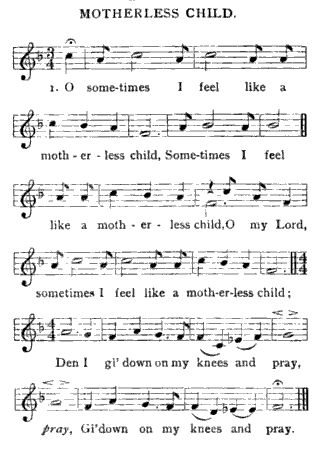
Original score of “Motherless Child” by William E. Barton, D.D., 1899.
The Blind Boys of Alabama sing “Sometimes I Feel Like a Motherless Child” the way men sing who have been walking toward a song their whole lives. Five voices, most of them blind since childhood, gathered in a room with nothing to prove and everything to lose. They have been singing together since 1939. We will come back to them. But the song was here before they were born, before their grandparents were born, before the paper it was first written down on.
Sometimes I Feel Like a Motherless Child was old before paper. It predates the ink William E. Barton used to transcribe it in 1899, predates the Fisk Jubilee Singers who carried it out of the fields and onto concert stages in the 1870s, predates the Civil War, predates the United States. The song moved through generations the way information moved through enslaved people’s bodies -- by mouth, by memory, by the only vessel the law allowed them to keep. An early public performance by the Fisk Jubilee Singers saved a university from bankruptcy. But the song was already old by then. It had traveled from the fields to the church to the concert hall, changing shape with every voice that carried it. Barton wrote down what he heard, knowing the notation could never capture what the singers did to the song on any given night.
The meaning is architecture you can see from every angle. The singer compares their pain to a child torn from its parents. The word “sometimes” is the only structural relief. Not always. Not forever. But sometimes the singer does not feel motherless. That single word repeated is the difference between despair and endurance -- between a song that documents suffering and a song that outlasts it. The spiritual was sung during the Civil Rights Movement as a warrant for a home that had not yet arrived. It has been arranged for symphony orchestras and sung a cappella in a prison yard. It refuses to stay in one genre because it belongs to all of them. A stateless citizen of American music. The melody is almost entirely pentatonic in the minor mode. The composer H.T. Burleigh arranged an exquisite setting in 1918, using impressionistic modal harmonies that suggest a past age in the first verse and more passionate struggle in the second. Burleigh understood that the song’s architecture was older than any single arrangement could contain.
Motherless Child
Listen while you read: Motherless Child | Spirit of the Century | 2001
A Song Carried by Giants
Paul Robeson made the earliest recordings starting in 1926. His bass-baritone carried the spiritual across the Atlantic to concert halls in London, Moscow, and Paris. He understood the song was not just American but universal -- the cry of every displaced person, every exile, every soul who looked at the horizon and wondered if there was a place they belonged. Mahalia Jackson recorded it for her 1956 album Bless This House and proved the spiritual could live inside the new sound of Black church music without losing its original architecture. Odetta performed it at Carnegie Hall on April 8, 1960, backed by a choir that pushed the song from lament into declaration. Her version landed in Pier Paolo Pasolini’s 1964 film The Gospel According to St. Matthew, a pairing that made explicit what the song had always known -- that it shared blood with the story of Christ abandoned by his father, dying alone, crying out into the silence.
Richie Havens opened Woodstock on August 15, 1969, with an improvised version he retitled “Freedom.” He had played every song he knew. The crowd kept calling for more. In desperation he reached for the spiritual that had been in his bones since childhood. He syncopated the rhythm and repeated the word “freedom” until it became a chant. That performance was the moment of Woodstock, captured on film, heard by millions, almost entirely improvised on the spot. Havens later said he was just trying to survive the moment. The survival became history. It also became the template for every artist who has since used a spiritual not as a museum piece but as a weapon.
The song has been covered by dozens of prominent artists across gospel, blues, folk, disco, hip-hop, and pop. Each found their own version of abandonment inside it. We have listed many of them below.
The Blind Boys of Alabama
The Blind Boys of Alabama first sang together in 1939 as part of the school chorus at the Alabama Institute for the Negro Deaf and Blind in Talladega, Alabama. The founding members were Clarence Fountain, George Scott, Velma Bozman Traylor, Johnny Fields, Olice Thomas, and the only sighted member, J.T. Hutton. They were students at a segregated school for blind Black children, run by an all-white faculty who forbade them from singing gospel music. The boys learned it anyway. They listened to the Golden Gate Quartet and The Soul Stirrers on the radio after lights out, absorbing the harmonies in the dark. Music was the one thing the institution could not regulate. In the dormitories at night, the radio belonged to them.
Our disability doesn’t have to be a handicap. It’s not about what you can’t do. It’s about what you do. And what we do is sing good gospel music. Ricky McKinnie, Blind Boys of Alabama
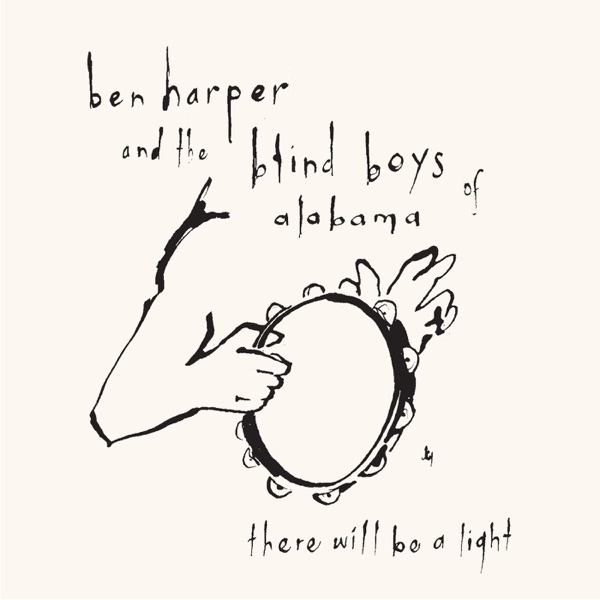
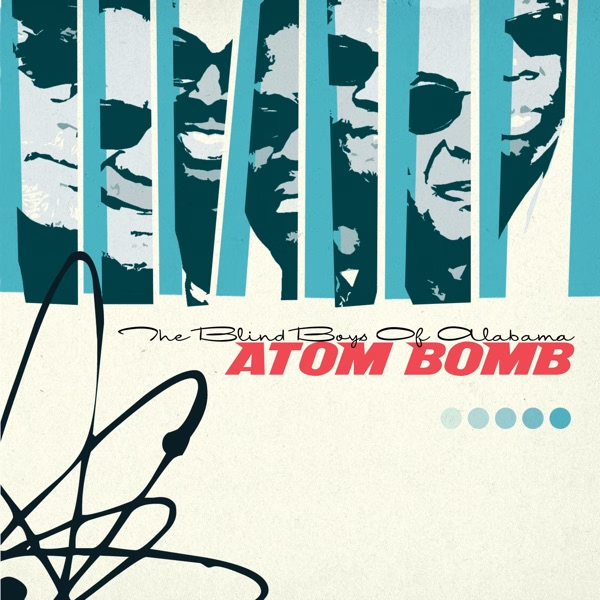
There Will Be a Light (2004)Atom Bomb (2005)
The earliest version of the group was called The Happy Land Jubilee Singers. They sang for World War II soldiers at nearby encampments, pocket change rattling in a jar. Their first professional performance was a radio broadcast on June 10, 1944, on station WSGN in Birmingham. The next year they dropped out of school and began touring the gospel circuit. In 1948 a promoter in Newark, New Jersey, booked them alongside another gospel act from Mississippi whose members were also visually impaired. The Jackson Harmoneers. The promoter advertised the event as a “Battle of the Blind Boys.” Both acts renamed themselves. The Five Blind Boys of Alabama and the Five Blind Boys of Mississippi. They often toured together, and the competition pushed them higher. The Blind Boys made their first recordings in 1948 on the Coleman label. Their first national hit was “I Can See Everybody’s Mother But Mine” in 1949. The title was a joke about their condition. The joke was a way of naming what they could not hide and refusing to be diminished by it.
Through the 1950s they were gospel royalty, but they resisted offers to cross over into secular music. Ray Charles’s manager dangled a major touring deal if they would sing pop. They said no. They stayed with gospel through the rise of soul in the 1960s, through the decline of traditional gospel in the 1970s, through Clarence Fountain’s brief solo career and his return in 1977. They performed at benefits for Dr. Martin Luther King Jr. and the Civil Rights Movement. They played churches and school auditoriums for four decades, largely unknown to mainstream white audiences. This did not seem to bother them. They had never been visible. What was forty more years of invisibility when you had already spent your whole life singing in the dark?
Everything changed in 1983. They were cast in The Gospel at Colonus, an African-American musical version of Sophocles’ Oedipus at Colonus. They played the blind prophet Tiresias and collectively the blinded Oedipus himself. They shared a stage with Morgan Freeman. The production won an Obie Award for Best Musical in 1984 and moved to Broadway in 1988. A door opened. The world that had ignored traditional gospel for four decades suddenly realized this group had been there the whole time, singing in a frequency the mainstream had not tuned to.
The Century’s Spirit
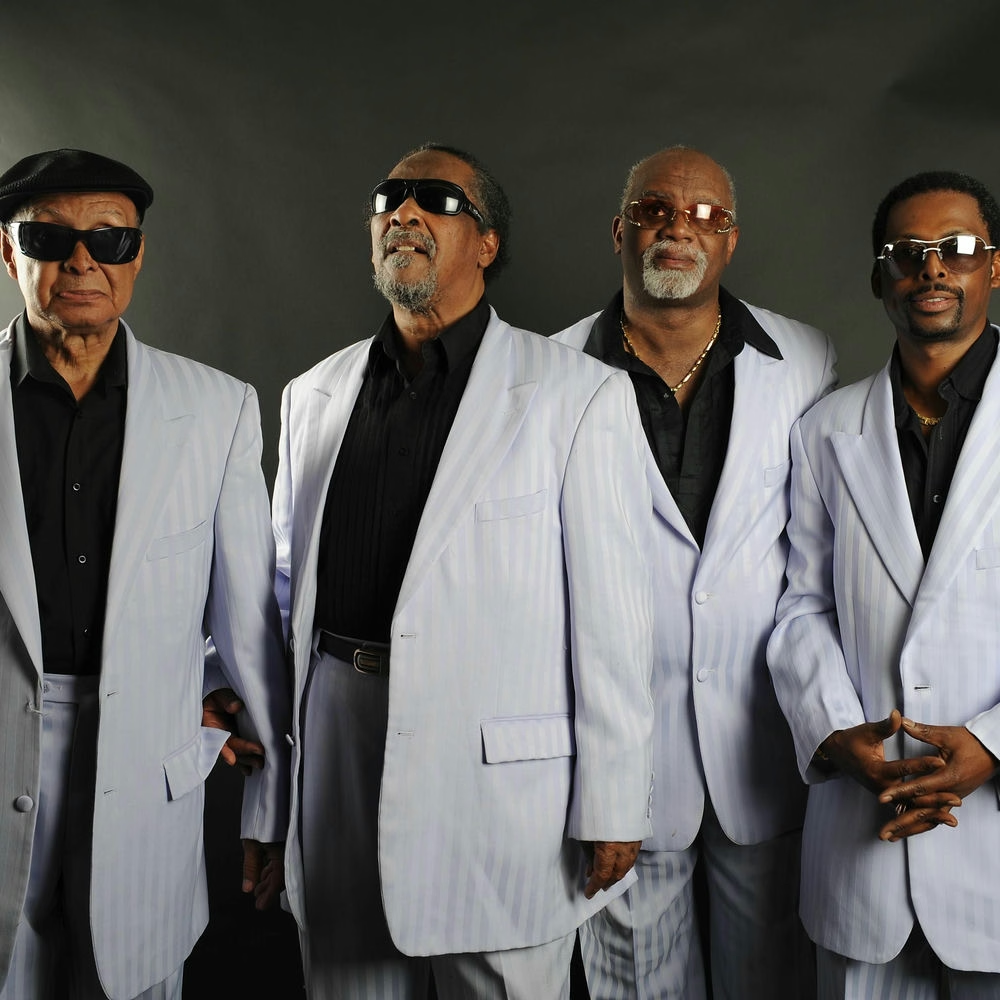
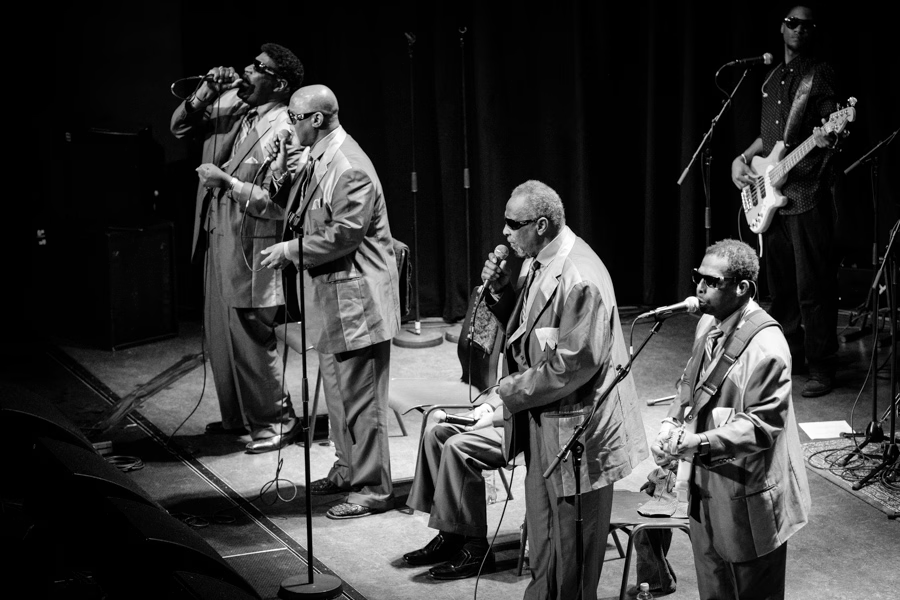
The Blind Boys of Alabama at Cosmopolite, Oslo, 2018. Photo: CC BY-SA 4.0
By the late 1990s the Blind Boys had become something they never expected. Elder statesmen of American music. They had released albums on small gospel labels for decades. In 2001 Peter Gabriel signed them to his Real World Records and produced Spirit of the Century, the album that introduced the Blind Boys to the global audience that had somehow missed them for sixty years. The album covered “I Just Want to See His Face” from The Rolling Stones. It arranged “Amazing Grace” to the melody of “The House of the Rising Sun.” A trick that made two traditional songs sound like they had always belonged together -- because in the geography of American music, they do.
And it included “Motherless Child.” A stark, nearly a cappella reading that strips away every arrangement added over a century of interpretation and returns the song to its essential architecture. There are no instruments. Just voices. Five men, most blind since childhood, standing in a room and singing a song that was old when their grandparents were born. The recording is not polished. It does not need to be. The harmonies are not blended in the studio-smooth sense. They are alive, breathing, leaning into each other at the turns where the pain of the lyric sharpens. The lead vocal cracks at one point. Not from error. From the weight of a song sung by enslaved people, by sharecroppers, by Freedom Riders, and now by six men who have spent their lives making music in the dark.
Sometimes I feel like a motherless child Sometimes I feel like a motherless child Sometimes I feel like a motherless child A long way from home
Sometimes I feel like I’m almost gone Sometimes I feel like I’m almost gone Sometimes I feel like I’m almost gone A long way from home
The Blind Boys understand that “a long way from home” is the entire sermon. The rest is qualification. Earth is not home. The body is not home. The home these men are singing about is a place their ancestors could only imagine, a place they themselves have never seen with their eyes but can describe with their voices. The spiritual was born in the fields where home was a memory of Africa and a promise of heaven. The Blind Boys, blind since childhood, have spent their lives singing about a home they have never seen. The metaphor lands differently when the people singing it have never laid eyes on anything at all. Their blindness is not a limitation they overcome in the song. It is the reason the song sounds the way it does. A group of men who cannot see singing about a home they have never seen to an audience that can see but has not arrived there either. That is not irony. That is theology.
Spirit of the Century won the Grammy for Best Traditional Soul Gospel Album. Four more Grammys followed, plus a Lifetime Achievement Award in 2009. The Gospel Music Hall of Fame inducted them in 2003, the Alabama Hall of Fame in 2010. The National Endowment for the Arts gave them a National Heritage Fellowship in 1994. First Lady Hillary Clinton handed it to them. They performed at the White House under three presidents. They recorded with Ben Harper, Lou Reed, Bonnie Raitt, Bon Iver, and Amadou and Mariam. Their cover of Tom Waits’ “Way Down in the Hole” opened the first season of The Wire.
Clarence Fountain died in 2018 at 88. His final performance was three weeks earlier in Baton Rouge. But the group continues to tour and record. Eighty-five years after they started. The longest-standing active music group in American history. Founded by blind children who refused to stop singing, who outlasted every trend and every industry shift not by adapting but by refusing to leave the place where they started.
“Motherless Child” was recorded in 2001 by a group that had already been singing together for sixty-two years. The song was older than the United States. The men who sang it were blind. And the result was not an interpretation of a spiritual. It was the spiritual returned to its original condition. A human voice reaching for something it cannot see, hoping it is there. The song has been reaching for the same thing for three centuries. It has not arrived yet. That is why we still sing it.
One song delivered to your inbox every Sunday morning.
Join the readers who start their Sunday with a story they didn't know they needed.
The Sunday Drop
One song. One story. Every Sunday.
No algorithms. No trending sections. Just a song someone loved and the story behind it. Delivered Sunday morning.
✓Check your email to confirm.
Free. No spam. Unsubscribe anytime.
Image Credits
1,449 artist portraits across 5 genres (Rock, Jazz, Soul, Blues, Folk).
1,363 sourced from Wikipedia (Creative Commons / Public Domain), 50 from
Deezer (promotional artwork).
"Motherless Child" -- The Blind Boys of Alabama (2001)
Traditional (Spiritual)
Original score of “Motherless Child” by William E. Barton, D.D., 1899.
The Blind Boys of Alabama sing “Sometimes I Feel Like a Motherless Child” the way men sing who have been walking toward a song their whole lives. Five voices, most of them blind since childhood, gathered in a room with nothing to prove and everything to lose. They have been singing together since 1939. We will come back to them. But the song was here before they were born, before their grandparents were born, before the paper it was first written down on.
Sometimes I Feel Like a Motherless Child was old before paper. It predates the ink William E. Barton used to transcribe it in 1899, predates the Fisk Jubilee Singers who carried it out of the fields and onto concert stages in the 1870s, predates the Civil War, predates the United States. The song moved through generations the way information moved through enslaved people’s bodies -- by mouth, by memory, by the only vessel the law allowed them to keep. An early public performance by the Fisk Jubilee Singers saved a university from bankruptcy. But the song was already old by then. It had traveled from the fields to the church to the concert hall, changing shape with every voice that carried it. Barton wrote down what he heard, knowing the notation could never capture what the singers did to the song on any given night.
The meaning is architecture you can see from every angle. The singer compares their pain to a child torn from its parents. The word “sometimes” is the only structural relief. Not always. Not forever. But sometimes the singer does not feel motherless. That single word repeated is the difference between despair and endurance -- between a song that documents suffering and a song that outlasts it. The spiritual was sung during the Civil Rights Movement as a warrant for a home that had not yet arrived. It has been arranged for symphony orchestras and sung a cappella in a prison yard. It refuses to stay in one genre because it belongs to all of them. A stateless citizen of American music. The melody is almost entirely pentatonic in the minor mode. The composer H.T. Burleigh arranged an exquisite setting in 1918, using impressionistic modal harmonies that suggest a past age in the first verse and more passionate struggle in the second. Burleigh understood that the song’s architecture was older than any single arrangement could contain.
Motherless Child
Listen while you read: Motherless Child | Spirit of the Century | 2001
A Song Carried by Giants
Paul Robeson made the earliest recordings starting in 1926. His bass-baritone carried the spiritual across the Atlantic to concert halls in London, Moscow, and Paris. He understood the song was not just American but universal -- the cry of every displaced person, every exile, every soul who looked at the horizon and wondered if there was a place they belonged. Mahalia Jackson recorded it for her 1956 album Bless This House and proved the spiritual could live inside the new sound of Black church music without losing its original architecture. Odetta performed it at Carnegie Hall on April 8, 1960, backed by a choir that pushed the song from lament into declaration. Her version landed in Pier Paolo Pasolini’s 1964 film The Gospel According to St. Matthew, a pairing that made explicit what the song had always known -- that it shared blood with the story of Christ abandoned by his father, dying alone, crying out into the silence.
Richie Havens opened Woodstock on August 15, 1969, with an improvised version he retitled “Freedom.” He had played every song he knew. The crowd kept calling for more. In desperation he reached for the spiritual that had been in his bones since childhood. He syncopated the rhythm and repeated the word “freedom” until it became a chant. That performance was the moment of Woodstock, captured on film, heard by millions, almost entirely improvised on the spot. Havens later said he was just trying to survive the moment. The survival became history. It also became the template for every artist who has since used a spiritual not as a museum piece but as a weapon.
The song has been covered by dozens of prominent artists across gospel, blues, folk, disco, hip-hop, and pop. Each found their own version of abandonment inside it. We have listed many of them below.
The Blind Boys of Alabama
The Blind Boys of Alabama first sang together in 1939 as part of the school chorus at the Alabama Institute for the Negro Deaf and Blind in Talladega, Alabama. The founding members were Clarence Fountain, George Scott, Velma Bozman Traylor, Johnny Fields, Olice Thomas, and the only sighted member, J.T. Hutton. They were students at a segregated school for blind Black children, run by an all-white faculty who forbade them from singing gospel music. The boys learned it anyway. They listened to the Golden Gate Quartet and The Soul Stirrers on the radio after lights out, absorbing the harmonies in the dark. Music was the one thing the institution could not regulate. In the dormitories at night, the radio belonged to them.
Our disability doesn’t have to be a handicap. It’s not about what you can’t do. It’s about what you do. And what we do is sing good gospel music. Ricky McKinnie, Blind Boys of Alabama
There Will Be a Light (2004)Atom Bomb (2005)
The earliest version of the group was called The Happy Land Jubilee Singers. They sang for World War II soldiers at nearby encampments, pocket change rattling in a jar. Their first professional performance was a radio broadcast on June 10, 1944, on station WSGN in Birmingham. The next year they dropped out of school and began touring the gospel circuit. In 1948 a promoter in Newark, New Jersey, booked them alongside another gospel act from Mississippi whose members were also visually impaired. The Jackson Harmoneers. The promoter advertised the event as a “Battle of the Blind Boys.” Both acts renamed themselves. The Five Blind Boys of Alabama and the Five Blind Boys of Mississippi. They often toured together, and the competition pushed them higher. The Blind Boys made their first recordings in 1948 on the Coleman label. Their first national hit was “I Can See Everybody’s Mother But Mine” in 1949. The title was a joke about their condition. The joke was a way of naming what they could not hide and refusing to be diminished by it.
Through the 1950s they were gospel royalty, but they resisted offers to cross over into secular music. Ray Charles’s manager dangled a major touring deal if they would sing pop. They said no. They stayed with gospel through the rise of soul in the 1960s, through the decline of traditional gospel in the 1970s, through Clarence Fountain’s brief solo career and his return in 1977. They performed at benefits for Dr. Martin Luther King Jr. and the Civil Rights Movement. They played churches and school auditoriums for four decades, largely unknown to mainstream white audiences. This did not seem to bother them. They had never been visible. What was forty more years of invisibility when you had already spent your whole life singing in the dark?
Everything changed in 1983. They were cast in The Gospel at Colonus, an African-American musical version of Sophocles’ Oedipus at Colonus. They played the blind prophet Tiresias and collectively the blinded Oedipus himself. They shared a stage with Morgan Freeman. The production won an Obie Award for Best Musical in 1984 and moved to Broadway in 1988. A door opened. The world that had ignored traditional gospel for four decades suddenly realized this group had been there the whole time, singing in a frequency the mainstream had not tuned to.
The Century’s Spirit
The Blind Boys of Alabama at Cosmopolite, Oslo, 2018. Photo: CC BY-SA 4.0
By the late 1990s the Blind Boys had become something they never expected. Elder statesmen of American music. They had released albums on small gospel labels for decades. In 2001 Peter Gabriel signed them to his Real World Records and produced Spirit of the Century, the album that introduced the Blind Boys to the global audience that had somehow missed them for sixty years. The album covered “I Just Want to See His Face” from The Rolling Stones. It arranged “Amazing Grace” to the melody of “The House of the Rising Sun.” A trick that made two traditional songs sound like they had always belonged together -- because in the geography of American music, they do.
And it included “Motherless Child.” A stark, nearly a cappella reading that strips away every arrangement added over a century of interpretation and returns the song to its essential architecture. There are no instruments. Just voices. Five men, most blind since childhood, standing in a room and singing a song that was old when their grandparents were born. The recording is not polished. It does not need to be. The harmonies are not blended in the studio-smooth sense. They are alive, breathing, leaning into each other at the turns where the pain of the lyric sharpens. The lead vocal cracks at one point. Not from error. From the weight of a song sung by enslaved people, by sharecroppers, by Freedom Riders, and now by six men who have spent their lives making music in the dark.
Sometimes I feel like a motherless child Sometimes I feel like a motherless child Sometimes I feel like a motherless child A long way from home
Sometimes I feel like I’m almost gone Sometimes I feel like I’m almost gone Sometimes I feel like I’m almost gone A long way from home
The Blind Boys understand that “a long way from home” is the entire sermon. The rest is qualification. Earth is not home. The body is not home. The home these men are singing about is a place their ancestors could only imagine, a place they themselves have never seen with their eyes but can describe with their voices. The spiritual was born in the fields where home was a memory of Africa and a promise of heaven. The Blind Boys, blind since childhood, have spent their lives singing about a home they have never seen. The metaphor lands differently when the people singing it have never laid eyes on anything at all. Their blindness is not a limitation they overcome in the song. It is the reason the song sounds the way it does. A group of men who cannot see singing about a home they have never seen to an audience that can see but has not arrived there either. That is not irony. That is theology.
Spirit of the Century won the Grammy for Best Traditional Soul Gospel Album. Four more Grammys followed, plus a Lifetime Achievement Award in 2009. The Gospel Music Hall of Fame inducted them in 2003, the Alabama Hall of Fame in 2010. The National Endowment for the Arts gave them a National Heritage Fellowship in 1994. First Lady Hillary Clinton handed it to them. They performed at the White House under three presidents. They recorded with Ben Harper, Lou Reed, Bonnie Raitt, Bon Iver, and Amadou and Mariam. Their cover of Tom Waits’ “Way Down in the Hole” opened the first season of The Wire.
Clarence Fountain died in 2018 at 88. His final performance was three weeks earlier in Baton Rouge. But the group continues to tour and record. Eighty-five years after they started. The longest-standing active music group in American history. Founded by blind children who refused to stop singing, who outlasted every trend and every industry shift not by adapting but by refusing to leave the place where they started.
“Motherless Child” was recorded in 2001 by a group that had already been singing together for sixty-two years. The song was older than the United States. The men who sang it were blind. And the result was not an interpretation of a spiritual. It was the spiritual returned to its original condition. A human voice reaching for something it cannot see, hoping it is there. The song has been reaching for the same thing for three centuries. It has not arrived yet. That is why we still sing it.