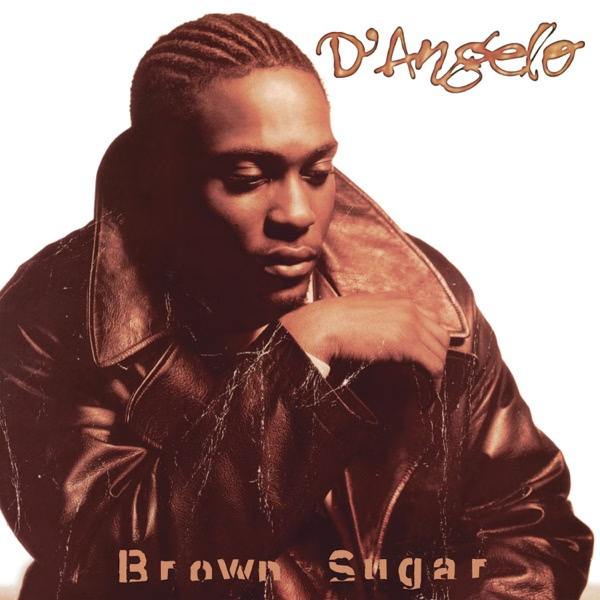
D’Angelo died on December 14, 2025, at 51. The grief has not settled into something you can hold. It shows up in unexpected places -- a playlist shuffle, a late-night deep dive, a friend saying “remember when we first heard Brown Sugar?” And then there is I Found My Smile Again. A deep cut from D’Angelo’s 1995 debut, buried on the second half between the singles and the slow burns. It is the quietest kind of triumph: a song about someone helping you find a part of yourself you thought was gone. Not a love song about possession. A love song about restoration.
The remarkable thing about I Found My Smile Again is that it exists at all in the catalog of a man whose manager, Kedar Massenburg, coined the term “neo-soul” to describe what he was doing. D’Angelo was twenty years old when he recorded Brown Sugar. He had already won three straight Amateur Night competitions at the Apollo, dropped out of school, moved to New York, and signed a publishing deal with EMI after a three-hour impromptu piano recital that left executives scrambling for a contract. He was called the next Stevie Wonder before he turned 22, a label that would crush most artists. This song is the exception. It is the one moment in his catalog where the guard drops completely. No metaphor. No distance. Just gratitude, direct and unguarded: I found my smile again, you helped me find my smile again.
The Smile Before the Weight
The full lyrics are deceptively simple. “I don’t know what it is that you’re doing, all I know is baby, that you’re shonuff doin’ it good.” No poetry. No wordplay. A young man telling someone they saved him. But the second verse reveals more: My smile, hello hello smile, I haven’t seen you in a while. Your love, girl your love, you make me feel like I’m on a cloud. And since I laid eyes on you, my spirit’s been brand new. The smile is a separate entity -- something that left without permission and had to be found again. Hello hello smile. Greeting it like an old friend who walked out mid-conversation and finally came back.
I found my smile again
You helped me find my smile again
I found my smile again
You helped me find my smile again
D’Angelo recorded Brown Sugar during 1994 and 1995 at Battery Studios and RPM Studios in New York, with additional sessions at Raphael Saadiq’s Pookie Lab in Sacramento. The production -- handled by D’Angelo himself alongside Bob Power and Ali Shaheed Muhammad of A Tribe Called Quest -- is warm and unhurried. A hip-hop drum pattern softened by live bass. Keyboard washes that sound like late summer. Angie Stone’s background vocals floating underneath like a second pulse. And then the outro -- “Honey baby got me smilin’, smilin’, smilin’” -- a breakdown to pure wordless gratitude, the sound of someone who has stopped trying to articulate joy and is just letting it come out however it comes.
The Man Who Could Not Smile for a Decade
After Brown Sugar, D’Angelo disappeared. Not from music entirely, but from the expectation machine. Voodoo came five years later in 2000 -- a masterpiece built on the kind of patience most labels do not permit. Darker, slower, more interior. Songs like Untitled (How Does It Feel) traded youthful gratitude for the cost of intimacy, the weight of the male gaze, the exhaustion of being desired, not known. Then another disappearance. Fourteen years until Black Messiah in 2014, arriving during the Ferguson protests, reframing everything he had ever done as political.
The man who sang I Found My Smile Again spent most of his adult life not smiling. He battled addiction, legal trouble, a near-fatal car accident in 2005, the slow erosion that comes when you are told you are a genius before you have figured out how to live. In 2015, he looked frail on stage, a shell of the man who had once played Voodoo in dark clubs to audiences who sat in reverent silence. The smile kept leaving. The question the song asks -- can someone help you find it? -- was the question of his entire life.
The Coda
I Found My Smile Again is not D’Angelo’s best song. It is not even the best song on Brown Sugar. But it is the most honest. A twenty-year-old prodigy who carried the weight of a nascent genre on his shoulders sat down at a piano and wrote the simplest thing he could think of: thank you. The singer who helped invent neo-soul, who made the term mean something by doing exactly what Prince told him to do -- write, produce, perform every part himself -- used none of those talents here. He used his voice. He used the truth. Twenty years later, after the disappearances and the comebacks and the end, that simplicity has not aged. The smile left. The smile came back. He wrote it down while he had it.
Video