T-Bone Walker did not invent the blues. But he invented what the blues sounded like after 1947. Before him, the blues guitar was acoustic, seated, polite -- a country thing played on a porch. T-Bone plugged into an amplifier, stood up in a tailored suit, and bent notes so slow and so wide that the guitar started speaking a language it had never spoken before. Call It Stormy Monday (But Tuesday Is Just as Bad) is the document of that invention -- a twelve-bar blues so perfectly constructed that every guitarist who came after has had to reckon with it. T-Bone Walker recorded it on September 13, 1947, in Hollywood, California, for Black & White Records, with producer Ralph Bass in the booth. It was the B-side. The A-side was “I Know Your Wig Has Gone.” History has a sense of humor.
The song is built on the days of the week, a blues tradition that goes back to the 1920s. Monday through Thursday are the grind. Friday is payday -- “the eagle flies” (the eagle on the US dollar, the oldest vernacular for a paycheck in the American blues lexicon). Saturday is escape. Sunday is church, repentance, and the promise to do better next week. B.B. King, who heard T-Bone and knew what he wanted to do with his life, called it “one of the best ways of singing the blues.” The cycle never breaks. The week always resets. That is the structure of working-class life, rendered in three minutes.
The Texas Showman
Walker was born Aaron Thibeaux Walker on May 28, 1910, in Linden, Texas. Blind Lemon Jefferson was a family friend -- the young T-Bone would lead the blind blues legend to gigs, watching him play from inches away. He learned guitar and banjo at 13, played carnivals as a teenager, danced and sang alongside Ma Rainey and Bessie Smith, and absorbed what it meant to command a stage. By the time he picked up an electric guitar in the late 1930s, he already knew how to put on a show his daughter Bernita described as “phenomenal” -- the splits, the behind-the-head playing, the facial expressions that made the women scream and the men applaud.
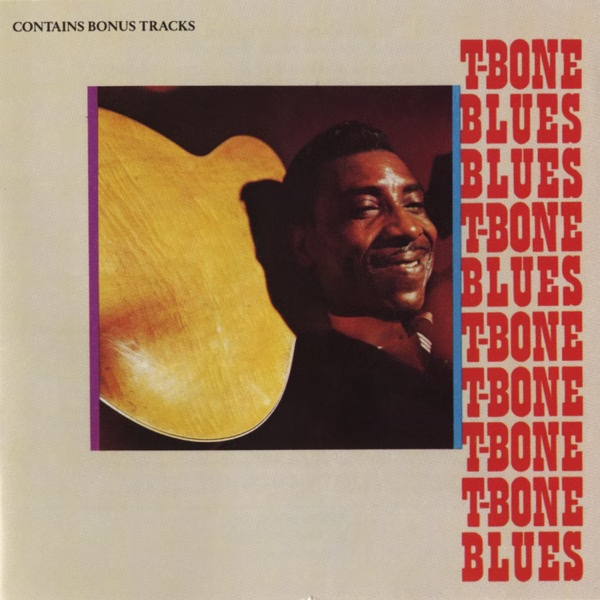
That showmanship became the blueprint for everything that followed. Chuck Berry took the showmanship. Jimi Hendrix took the behind-the-head playing and the feedback. B.B. King took the single-note sustain and made it a whole career. T-Bone did it first, in a suit, with a Gibson, on a stage that had never seen anything like him.
They call it stormy Monday, but Tuesday’s just as bad
Wednesday’s worse, and Thursday’s also sad
Yes the eagle flies on Friday, Saturday I go out to play
Sunday I go to church, then I kneel down and pray
That is the song in five lines. Five lines that contain the entire arc of working-class life in the 20th century American South: labor, release, and the collision of worldly sin and Sunday salvation. T-Bone did not invent the structure. He perfected it. The guitar solo -- a single chorus of bent notes, each one held just long enough to hurt -- is the part every guitarist remembers. It is not fast. It is not flashy. It is a man making one note say everything.
The 78 That Refuses to Die
“Stormy Monday” has been covered by so many artists that the list reads like a genealogy of 20th century Black music: B.B. King, Albert King, Bobby “Blue” Bland, the Allman Brothers Band, Eric Clapton, Latimore, Etta James, Lou Rawls, Ike & Tina Turner. The Allman Brothers recorded it for At Fillmore East in 1971, stretching it to eight minutes of dual-guitar conversation between Duane Allman and Dickey Betts -- a version so definitive that it introduced the song to a generation of white rock audiences who had never heard T-Bone’s name. The Allmans knew where the song came from. They credited T-Bone every night.
In 2008, the Library of Congress added the original 1947 recording to the National Recording Registry, calling it “culturally, historically, or aesthetically significant.” The song that started as a B-side on a 78 RPM record, cut by a Texas showman in a Hollywood studio, had become a permanent part of the American archive. The week keeps turning. The eagle still flies. And every time a guitarist bends a note and holds it a beat too long, they are quoting T-Bone Walker whether they know it or not.
Video